SEND
Crown Wood Primary School is ambitious for all pupils and we believe that there is no ceiling on what can be achieved by anyone, regardless of their circumstance or background. We are committed to providing a supportive and inclusive learning environment, giving every young person the opportunity to fulfil their potential now, and in the future.
The leaders at Crown Wood Primary School are leaders for all pupils, enabling our teachers to be teachers of all pupils. Crown Wood Primary School is committed to distributed leadership to secure the best possible provision and outcomes for pupils with special educational needs. We have the same ambition for all our pupils, and recognise the importance and impact of prioritising our responsibilities to pupils with special educational needs.
We work in partnership with pupils and their families in identifying and providing for special educational needs. Where appropriate, we also work in partnership with other agencies. We recognise the importance of communication being inclusive, accessible and culturally sensitive to achieve effective partnership working.
Our graduated approach
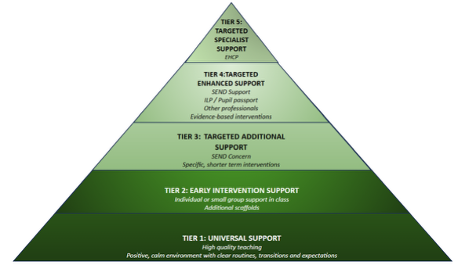
At Crown Wood Primary School, we have a graduated approach to pupils’ needs. Any support follows the schools’ graduated approach so that pupils, first and foremost, access high
quality inclusive teaching within their classes. Where more support is required, pupils will access targeted and specialist support as detailed below.
What does it mean to have a Special Educational Need
A pupil has SEN if they have a learning difficulty or disability that requires special educational provision to be made for them.
They have a learning difficulty or disability if they have:
-
A significantly greater difficulty in learning than most others of the same age; or
-
A disability that prevents or hinders them from making use of facilities of a kind generally provided for others of the same age in mainstream schools.
Special educational provision is educational or training provision that is additional to, or different from, that made generally for other children or young people of the same age by mainstream schools.
What this means at Crown Wood Primary School
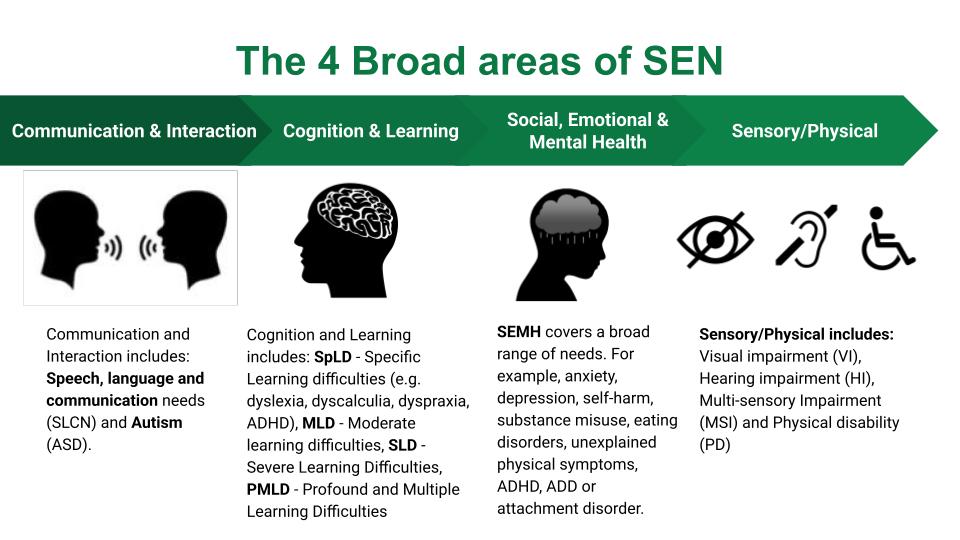
Crown Wood Primary School is an inclusive primary school that works in partnership with children and their families to support needs across all four broad areas of need. Our school currently provides additional and/or different provision for a range of needs, including:
-
Communication and interaction, for example, autistic spectrum disorder, speech and language difficulties.
-
Cognition and learning, for example, specific learning difficulties (dyslexia, dyspraxia).
-
Social, emotional and mental health difficulties, for example, attention deficit hyperactivity disorder (ADHD).
-
Sensory and/or physical needs, for example, visual impairments, hearing impairments, processing difficulties, epilepsy.
Our greatest area of need is Social Emotional and Mental Health and Speech, Language and communication needs, and we therefore have a particular focus on building whole-school and whole-class approaches to support pupils with learning needs.
We have been able to designate two spaces within the school for pupils to access at appropriate times within the day to support their sensory and/or emotional regulation. The Cubbie and Tree Tops (Nurture space).
Our SEND Team
|
Mrs Winchcombe
|
At Crown Wood, inclusion isn't an add-on or a separate initiative; it is woven into the very fabric of our daily school life. We believe that every child in our community deserves to feel valued, safe, and empowered to succeed. By working hand-in-hand with families, tailoring our Individual Learning Programmes, and removing barriers to learning, we ensure that every single child – regardless of their starting point – can thrive, belong, and fully participate in everything our school has to offer. |
|
Miss Chamberlain
|
I am deeply passionate about fostering an inclusive and nurturing school community where every child feels a sense of belonging. My mission is to support and encourage our pupils to succeed across all areas of need, while working closely with families and external agencies to ensure our children have the holistic support they need to thrive. |
|
Mrs Ruck,
|
Every child learns differently, but every child belongs completely. |
|
Miss Halsall,
|
Inclusion isn’t just a place where we put children; it’s a promise we make to them. It’s all about clearing away the hurdles, so every single learner can stand tall, feel like they truly belong, and reach as high as they want to go. |




Identification and assessment of children with SEND
We will assess each pupil’s current skills and levels of attainment on entry, which will build on previous settings and key stages, where appropriate. Class teachers will make regular assessments of progress for all pupils and identify those whose progress:
-
Is significantly slower than that of their peers starting from the same baseline.
-
Fails to match or better the child’s previous rate of progress.
-
Fails to close the attainment gap between the child and their peers.
-
Widens the attainment gap.
-
This may include progress in areas other than attainment, for example, social needs.
-
Slow progress and low attainment will not automatically mean a pupil is recorded as having SEN.
When deciding whether special educational provision is required, we will start with the desired outcomes, including the expected progress and attainment, and the views and aspirations of the pupil and their parents/carers. We will use this to determine the support that is needed and whether this can be provided by adapting our core offer, or whether something additional is needed.
We use a range of assessments to identify pupils with SEN. These include behaviour logs (BROMCOM), PiXL Tests (termly to support teacher assessment), IDL screeners (Literacy), SDQs and The Boxall Profile amongst other screeners in identifying pupils with SEN. These assessments are used in the ‘assess, plan, do, review’ cycle.
We will have an early discussion with the pupil (where appropriate) and their parents when identifying whether they need special educational provision. These conversations will make sure that:
-
Everyone develops a good understanding of the pupil’s areas of strength and difficulty.
-
We take into account the parents’ concerns.
-
Everyone understands the agreed outcomes sought for the child.
-
Everyone is clear on what the next steps are.
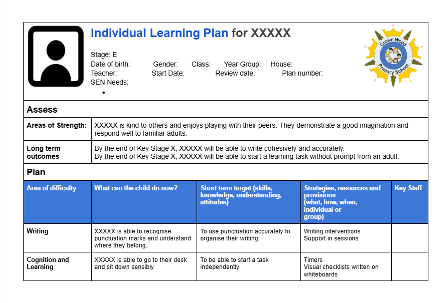
Provision beyond quality first teaching/ ordinarily available will be recorded on an individual learning plan and targets set. These will be SMART (specific, measurable, achievable, realistic and time-bound). These are recorded on Edukey and accessible to parents online.
Targets are reviewed at least termly with parents in a formal meeting. Reviews are recorded and accessible to parents via the Edukey system. Children are invited to discuss their progress towards targets and their comments are added to reviews where appropriate.
Pupils with an Education, Health and Care plan share their views at their annual review and work with staff to share their aspirations. This is recorded as part of a PowerPoint, scrap book, Video or in other ways depending on the child. Some pupils attend reviews to share their work verbally.
Coffee mornings/afternoons are also planned (half termly) and the SENCO invites agencies to engage parents and offer additional support beyond the school. The Mental Health Support team attend these and also offer consultations at face to face parent consultations (at least once per year).
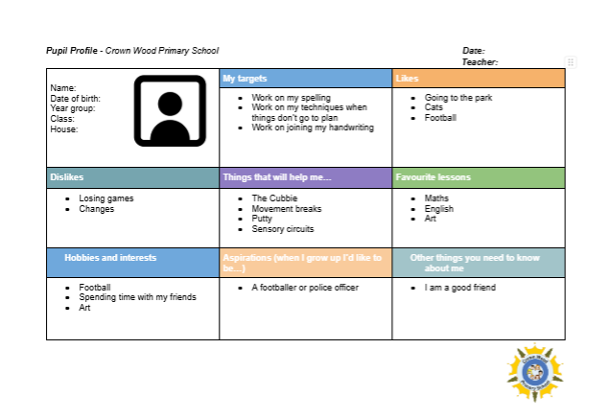
Pupil Passport
A pupil passport is a regularly reviewed document that contains the needs, strengths and individual strategies for every student with an EHCP or on SEN Support. These are developed in partnership with pupils and their parents/carers. Where appropriate, they might also include strategies recommended by other professionals.
Learning Plan
Some pupils who require more specialised support will have Individualised learning plans to complement pupil passports. For example, an individualised learning plan will be used to:
-
Track progress against long-term outcomes in Educational, Health and Care Plans (EHCNAs) for pupils working below age related expectations.
-
Inform medium-term and daily curriculum planning and provision where children are accessing adapted curriculum pathways.
-
Inform intervention planning.
Universal provision – high quality teaching
Crown Wood Primary School ensures that a universal provision of high quality teaching is able to address gaps in foundational knowledge and skills. Through evidence-informed classroom routines and a well-planned curriculum, teachers are able to address reading fluency and accuracy, communication and language skills, writing composition and number facts. Furthermore, our carefully selected and sequenced curricula ensure foundational subject-specific knowledge is secure at every step. For some students, effective in classroom targeted support ensures gaps are identified and tackled quickly through our responsive and adaptive classroom practice.
We support all children, including those with SEND by using high-quality teaching strategies which include modelling, breaking information up into smaller 'chunks', repeating instructions, checking for understanding and allowing time to respond. Staff also receive professional development on strategies that are particularly beneficial for children with particular needs, such as executive functioning skills.
Teachers are made aware of pupils' strengths, needs and appropriate adaptations and adjustments via their individual learning plans and One Page Profiles. Their Learning plans and One Page Profile guides teachers to know which strategies to prioritise for each pupil and/or which adaptations or adjustments are required to ensure the pupil can access the learning. ILPS and One Page profiles are reviewed termly by class teacher.
Targeted support
At Crown Wood Primary School, we have the following interventions:
-
Group support (within the class) – the goal is to provide immediate, focused, and short-term intervention to close this gap quickly, so the pupil can return to accessing the core curriculum alongside the main group, preventing the small gap from becoming a significant barrier.
-
Nurture Group support –pupils are identified for Nurture Group support because they are exhibiting gaps in social, emotional, and behavioral development which are preventing them from accessing learning effectively in the main classroom.
-
Fine Motor Skills (Pegs to Paper) – the aim is to improve the speed, legibility, and endurance of handwriting, as well as independence in tasks like dressing or manipulating small objects.
-
Play therapy – a targeted therapeutic intervention that uses play as the medium through which pupils can express themselves, process emotions, and address psychosocial difficulties.
-
Counselling – counselling is a formal therapeutic intervention providing a safe, confidential space for pupils to explore and process emotional distress, personal difficulties, and mental health concerns.
-
Canine Therapy – canine Therapy involves interaction with a trained therapy dog and handler to achieve specific educational, behavioural, or emotional goals.
-
The Cubbie – is a specific type of sensory or therapeutic space designed to support emotional regulation and self-soothing for pupils who become overwhelmed in the main school environment.
-
Touch typing – touch typing is a skill-based intervention focused on teaching pupils to type accurately and efficiently without looking at the keyboard.
-
Additional Forest school – a therapeutic and developmental intervention delivered in an outdoor, natural setting, focusing on holistic development outside of standard curriculum teaching.
-
IDL – IDL is a computer-based, multisensory program specifically designed to support the literacy and numeracy development of pupils.
-
Sensory circuits – is a targeted, short, daily physical activity program designed to help pupils regulate their bodies and minds, preparing them for learning.
-
Reading Eggs – is a structured, online program that uses interactive games and activities to teach foundational reading skills in a fun, engaging, and personalised way.
-
Exploring Neurodiversity groups – is a supportive, psychoeducational group focused on fostering self-understanding, acceptance, and advocacy in neurodivergent pupils.
-
Self-regulation groups – is a psychoeducational and practical intervention that teaches pupils strategies to manage their energy, emotions, and attention (often based on Zones of Regulation).
-
Well-being and mindfulness sessions – are a therapeutic intervention focused on teaching pupils techniques for emotional awareness, relaxation, and present-moment attention.
Specialist support
At Crown Wood Primary School, we work in partnership with a range of external agencies who support with the planning and delivery or specialist interventions. This includes:
-
Occupational Therapy support – pupils are identified when difficulties related to fine motor skills, gross motor skills, sensory processing, or visual perception are significantly impacting their ability to fully participate in school activities.
-
Speech and Language support – Speech and Language Therapy (SaLT) support is a specialist intervention designed to help pupils with Communication and Interaction needs. Pupils are identified when they have difficulties with understanding language (receptive language), using language (expressive language), speech sound production (articulation), or social communication skills (pragmatics). These difficulties are significant barriers to learning, social relationships, and accessing the curriculum. The aim is to develop specific communication skills to help pupils express their needs, understand instructions, and participate successfully in school life.
Staff training
Our SENCO has completed her NPQSENCO qualification. The school prioritises time for the SENCO to be able to work alongside other staff in the school to build expertise in the classroom.
Some staff also receive additional training in a particular specialism, such as teaching assistants who are trained In Nurture based principles. We also have staff who are Team Teach trained with a particular focus on de-escalation.
SEND-specific training has been delivered on the following areas:
-
Executive functioning
-
Pegs to paper
-
Sensory processing
-
Provision planning and mapping
-
Attachment and trauma
-
Adaptive teaching
We commission additional support from Mabel, an online Speech and Language therapy team.
Useful links
Teacher Handbook: SEND
With contributions from specialists across the sector, the handbook is a comprehensive resource for teachers and parents to use over time. It brings together practical examples of high-quality teaching – placing focus on removing barriers to learning, getting to know and understand individual learners, and bringing to life the graduated approach.
To access this free resource, click on the link below and sign up to Whole School SEND:
Whole School SEND Online CPD Units
Free, flexible online learning to help develop inclusive practice.
Other useful links
Our SEN policy, SEN Information report and accessibility plan can be found on our School Policies & Documents page here.
Our SEND local offer can be found here.